
Arlington Heights Epoxy Flooring has been installing polyaspartic floor coating systems for homes and businesses in Arlington Heights, IL for more than 20 years, serving surrounding cities including Prospect Heights, Deerfield, Barrington, Lake Zurich and Wood Dale. Polyaspartic is a fast-curing, aliphatic coating related to polyurea, and it has changed how quickly a coated floor can return to service. Used well, it gives a hard, glossy, UV-stable surface that shrugs off road brine, hot tires and heavy foot traffic.
Its speed is also its risk. A coating that sets in minutes leaves no room for a slab that was not prepared, and it does nothing to stop moisture rising from below. We grind every slab with diamond tooling, repair cracks and test moisture before a polyaspartic system goes down, and the proposal names the product, the layers and the finished thickness so you know exactly what you are getting.
We use polyaspartic in two ways: as a full system for floors that have to return to service quickly, and as the topcoat over epoxy for floors that need both build and wear resistance. It serves residential garages and basements as well as retail floors, showrooms and commercial service areas, and the right build differs between them.
What Makes Polyaspartic Different From Epoxy
UV Stability and Color Retention
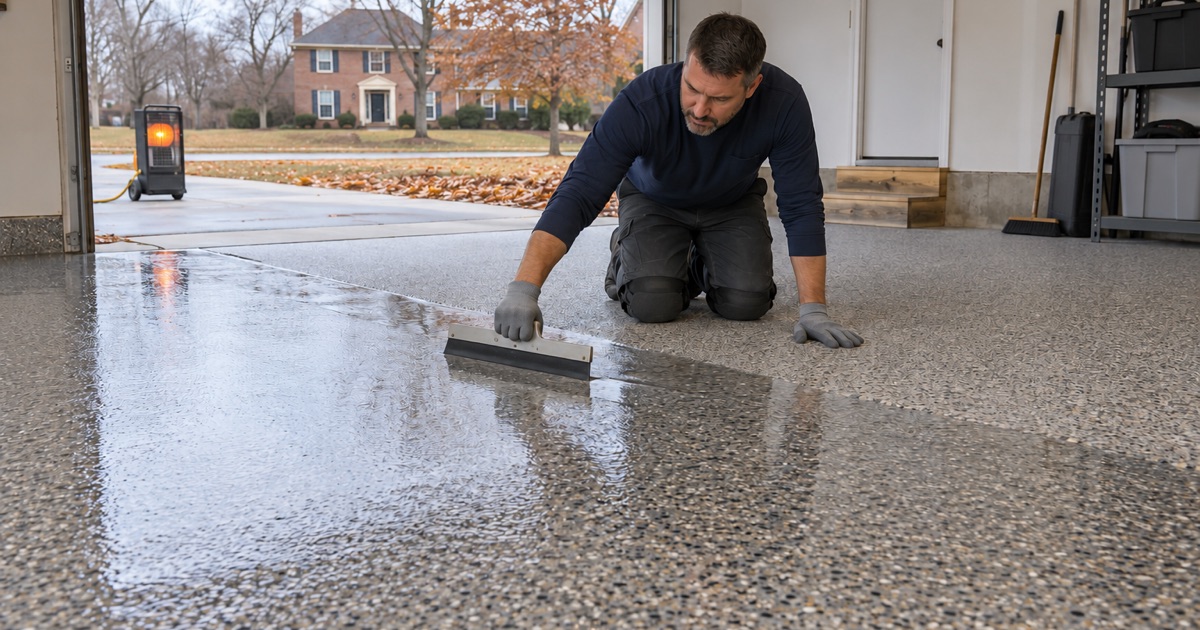
Standard epoxies yellow when exposed to sunlight, which shows clearly near open garage doors and storefront windows. Polyaspartic is aliphatic, so it holds its color under ultraviolet light without ambering. That makes it the natural topcoat for any floor that sees daylight, and the reason we rarely finish a garage with epoxy alone.
Cure Speed and Working Time
Polyaspartic cures in hours rather than days, which is why it can return a floor to service so quickly. The tradeoff is a short working time once the components are mixed, so it is applied in small batches by a crew that knows the product. Rushed or inexperienced application shows up as roller marks, bubbles and uneven gloss that cannot be fixed without abrading and recoating.
Abrasion, Chemicals and Road Brine
Polyaspartic topcoats resist abrasion and chemicals well, including the calcium chloride brine and rock salt that arrive on tires every winter. Gasoline, oil and antifreeze wipe off rather than staining. On a garage floor, that hard topcoat is what keeps salt from reaching the concrete, where calcium chloride can attack the cement paste and scale the surface.
Residential Polyaspartic Floor Coating
Fast-Turnaround Garage Floors
For homeowners who cannot spare their garage for several days, a polyaspartic system can mean parking inside again much sooner than with a full epoxy build. We still diamond grind the slab, fill cracks and test moisture first. When the slab needs more preparation, the schedule says so, because a fast coating over a poorly prepared floor simply fails faster.
Sunlit and South-Facing Garages
A garage that sits with its door open on summer afternoons, or one with windows facing south or west, puts heavy UV exposure on the floor near the door. An epoxy-only floor there can turn a different shade from the back wall within a few seasons. A polyaspartic topcoat keeps the color even from the threshold to the back wall.
Basements, Mudrooms and Workshops
In basements and mudrooms, polyaspartic gives a hard, easy-clean surface with little downtime, often finished with a flake or quartz broadcast for texture. Basement slabs bring their own moisture questions, so we test with ASTM F2170 probes or calcium chloride kits first. If vapor is high, a moisture-mitigation primer goes under the system.
Commercial Polyaspartic Floor Coating
Overnight and Weekend Installs
Retail stores, restaurants and offices that cannot close for days are where polyaspartic earns its place. We can often grind, coat and topcoat a section overnight or over a weekend, returning it to service by opening time. Phasing the work by zone keeps the rest of the building operating, and the schedule is set in the proposal.
Showrooms and Customer-Facing Floors
Auto showrooms, salons and storefronts want a bright, clear floor that keeps its color near windows and stands up to foot traffic and rolling displays. Polyaspartic delivers that gloss without ambering, and it can be recoated when traffic lanes wear rather than stripped. We tune the sheen and texture to balance appearance with slip resistance.
Service Areas and Back-of-House
In service bays, storage rooms and back-of-house corridors, polyaspartic topcoats resist oil, fluids and cart traffic and return to service quickly after repairs. Where a floor sees hot washdown or constant standing water, we may recommend urethane cement instead, since no single coating suits every commercial environment.
Where Fast Cure Needs Careful Handling
Temperature, Humidity and Dew Point
Many polyaspartics tolerate cooler conditions than standard epoxy, but every manufacturer still sets limits for slab temperature, humidity and the spread between the slab and the dew point. Coating too close to the dew point traps condensation and can cause cloudiness and bond problems. We measure conditions at the slab before every coat.
Moisture Still Comes First
Fast cure does nothing to stop vapor rising through a slab. A polyaspartic coating over a damp floor can blister or delaminate just like epoxy. We test moisture as a line item on every job and use a moisture-mitigation primer when readings call for one, rather than relying on speed to cover the problem.
Illinois VOC Limits
Illinois limits the volatile organic content of floor coatings under 35 Ill. Adm. Code Part 223, and the rule applies to the contractor applying the coating, not just the manufacturer. We choose polyaspartic products that fall within those limits and never thin them beyond what the label allows, which also keeps odor down in occupied buildings.
Our Step-by-Step Polyaspartic Floor Coating Process
Step 1: Inspection, Testing and Proposal
We inspect the slab, map cracks and old coatings, and test for moisture. The proposal names the system, the products, each layer and the finished thickness, along with the warranty exclusions, moisture first, read out before you sign.
Step 2: Grinding and Repairs
The slab is diamond ground with dust extraction to open the surface, and cracks, spalls and pits are filled and ground flush. Control joints are filled or left open depending on whether they are still moving. Because a polyaspartic system sets so quickly, there is no second chance to fix a missed spall once coating starts, so this stage gets the most time on the schedule.
Step 3: Base Coat and Broadcast
With conditions confirmed at the slab, the primer or base coat goes down, followed by a vinyl flake or quartz broadcast if your system includes one. Excess broadcast is scraped and vacuumed once the base coat has set. On a fast-turnaround job this is often only a few hours after the base coat, which is where polyaspartic saves most of its time compared with an all-epoxy build.
Step 4: Polyaspartic Topcoat and Handover
The polyaspartic topcoat is applied in controlled batches for an even film and finish. We tell you when the floor can take foot traffic, furniture and vehicles, and leave care instructions so the finish stays bright. Those instructions cover the cleaners to use, how to move winter slush off a garage floor, and when a worn traffic lane is ready for a fresh topcoat rather than a full replacement.
- 20+ Years Coating Concrete
- Moisture Tested Before Quoting
- Itemized Written Proposals