Arlington Heights Epoxy Flooring has been installing metallic epoxy floor systems in Arlington Heights, IL for more than 20 years, serving surrounding cities including Prospect Heights, Deerfield, Barrington, Lake Zurich and Wood Dale. A metallic floor uses reflective pigments suspended in clear, self-leveling epoxy to create a marbled, almost liquid surface with depth that changes as light moves across it. It is the most decorative floor we install, and the one that depends most on the hand of the installer.
That artistry sits on the same foundation as every other floor we coat. The slab is diamond ground to open the surface, cracks and old coatings are dealt with first, and moisture is tested as a line item, because a metallic floor that blisters is a very visible failure. The written proposal names the products, the layers and the finished thickness, along with the sample colors you approved.
We install metallic floors in basements, living areas and showcase garages, and in showrooms, salons, offices and restaurants. The residential and commercial versions use similar materials, but they differ in scale, scheduling and how hard the floor will be used, and the build changes to suit each.
How a Metallic Epoxy Floor Gets Its Look
Metallic Pigments in Self-Leveling Epoxy
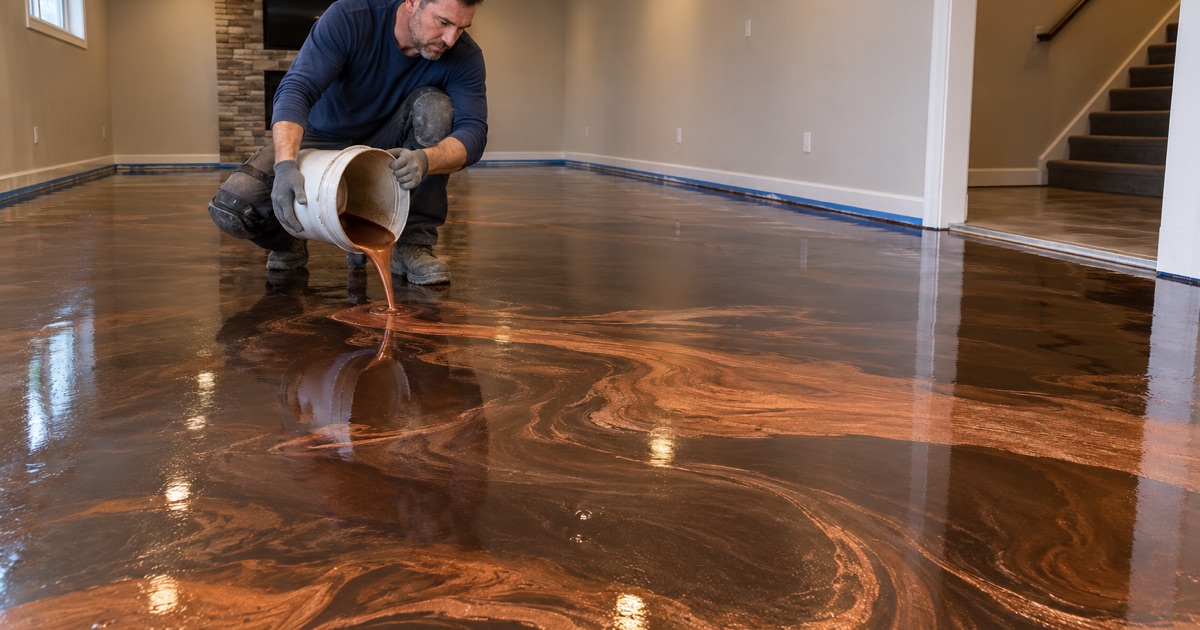
Metallic floors use fine, reflective mica-based pigments mixed into a clear 100% solids epoxy poured over a tinted base coat. While the epoxy is wet, the pigments shift and settle, catching light at different angles and creating the swirling, pearlescent effect. The base color under the metallic layer strongly affects the final tone, so we choose the two together.
Working the Pattern by Hand
The installer shapes the pattern while the resin is still fluid, using rollers, brushes, trowels and controlled air to create waves, veins, lava-like flows or soft clouds. Timing is everything: too early and the pattern fades back together, too late and the tool marks stay. That window is why we work in planned sections and keep experienced hands on every metallic job.
Colors, Layers and Effects
Metallic floors range from soft silver and pewter to deep copper, bronze, ocean blues and bold multicolor blends. Two or three colors can be layered for more movement, and a second metallic layer adds depth. We lay sample boards with your chosen colors, so you see them in your room’s own lighting before any resin goes down.
Residential Metallic Epoxy Floors
Basements and Living Spaces
A finished basement or family room is one of the best places for a metallic floor, because it is protected from sunlight and road salt and the look can stand in for tile or stone. Basements also bring moisture questions, so we test every slab with ASTM F2170 probes or calcium chloride kits and add a moisture-mitigation primer when readings call for one, before any decorative layers go down.
Showcase Garages
Metallic floors make a striking garage for collectors and hobbyists, but a garage that takes a daily driver through a northern Illinois winter is a hard place for any high-gloss finish. Calcium chloride brine and grit dull and scratch the surface, and hot tires stress it. For a showcase garage we use a thick, UV-stable polyaspartic topcoat; for a working garage we often recommend a flake system instead.
Home Bars, Offices and Studios
Smaller spaces such as home bars, offices, studios and lower-level entertainment areas suit metallic floors well, since the pattern becomes the room’s feature. We plan transitions at doorways, around built-ins and against other flooring carefully, because clean edges matter more on a decorative floor than on a utility surface.
Commercial Metallic Epoxy Floors
Showrooms, Salons and Retail
Car dealerships, boutiques, salons and galleries use metallic floors to make a strong first impression. In commercial settings we specify a harder, thicker topcoat, plan traffic paths and entryways for wear, and can add logos or color zones within the metallic layer. A periodic topcoat refresh keeps a busy floor looking new without redoing the decorative coat.
Offices, Lobbies and Restaurants
Office lobbies, conference areas and dining rooms benefit from a metallic floor that is easy to clean and visually distinctive. Where food, drinks or wet shoes are part of daily traffic, we add slip resistance to the topcoat and talk through cleaning methods. For commercial kitchens themselves, we recommend a textured, food-code-ready system rather than a decorative metallic finish.
Scheduling Around a Business
A metallic floor needs several days of controlled conditions, so commercial jobs are planned around closures, weekends or phased areas. The space must stay free of foot traffic, dust and drafts while each coat cures. We set the schedule in the proposal, so you know exactly when each area will be out of service and when it reopens.
What a Metallic Floor Demands
A Flat, Sound Slab
Self-leveling epoxy flows toward low spots and thins over high ones, so dips, ridges and patched areas show up clearly in a metallic floor. We grind the slab flat, fill cracks, pits and joints and smooth repairs carefully before the base coat. A floor with significant movement or extensive cracking is often better served by a different system, and we tell you so.
Controlled Temperature and Humidity
Metallic epoxy is sensitive to conditions. Cold slabs slow the flow of the resin, drafts can push the pattern, and humid air or a slab too close to the dew point can cause amine blush that clouds the finish. We check slab temperature and the dew point spread before each coat, close off airflow and keep unvented heaters out of the room.
Protecting the Finish
The clear topcoat protects the metallic layer from abrasion and chemicals and sets the final sheen. We usually finish with a polyaspartic or polyurea topcoat, which resists scratching better than epoxy alone and does not amber in sunlight. Adding a fine aggregate improves slip resistance where the floor may get wet.
Our Step-by-Step Metallic Epoxy Floor Process
Step 1: Design Consultation and Testing
We review colors and effects, lay sample boards in your space and inspect and moisture test the slab. The proposal sets out the design, each layer, the products and the finished thickness, along with warranty exclusions, moisture first.
Step 2: Grinding and Surface Repair
The slab is diamond ground with dust extraction, and cracks, joints and low spots are filled and ground flat, since the metallic layer will reveal any unevenness. We check the repaired floor with a straightedge and raking light before any decorative work begins, because a ridge missed here becomes a permanent streak.
Step 3: Primer and Tinted Base Coat
A primer suited to the moisture readings goes down, followed by a tinted base coat that sets the underlying tone of the floor. The base color is matched to the approved sample board, because it shows through and shifts the metallic colors above it.
Step 4: Metallic Layer and Design Work
The metallic epoxy is poured and worked by hand in sections to create the approved pattern, with conditions in the room held steady during the cure. Doors stay closed and fans stay off, since even a light draft can drag the pigment and leave a visible line across the pattern.
Step 5: Clear Topcoat and Final Cure
The protective topcoat is applied, with any slip-resistant additive. We tell you when foot traffic, furniture and normal use can return, and leave care guidance to keep the gloss intact.
- 20+ Years Coating Concrete
- Moisture Tested Before Quoting
- Itemized Written Proposals