
Arlington Heights Epoxy Flooring has spent more than 20 years grinding and finishing polished concrete floors in Arlington Heights, IL, serving surrounding cities including Prospect Heights, Deerfield, Barrington, Lake Zurich and Wood Dale. Polished concrete is not a coating laid on top of the slab; it is the slab itself, cut down with diamond tooling, hardened from within and burnished until it reflects light. That makes it one of the most durable floors you can have, and one of the least forgiving to install poorly.
Because the finished floor is the concrete you already have, the result depends on what is in it. We start every job by grinding a test section, so you see the color of the paste, how much stone is near the surface and which patches or cracks will show before a price is set. The written proposal then names the level of aggregate exposure, the densifier and guard we will use, and the sheen you can expect.
We polish floors in warehouses, showrooms, offices and schools, and in basements and living spaces in homes. The diamond sequence is the same in both, but the planning is not: commercial floors are scheduled around operating hours and traffic, while residential jobs focus on dust control, furniture and how the floor will feel to live on.
How a Polished Concrete Floor Is Made
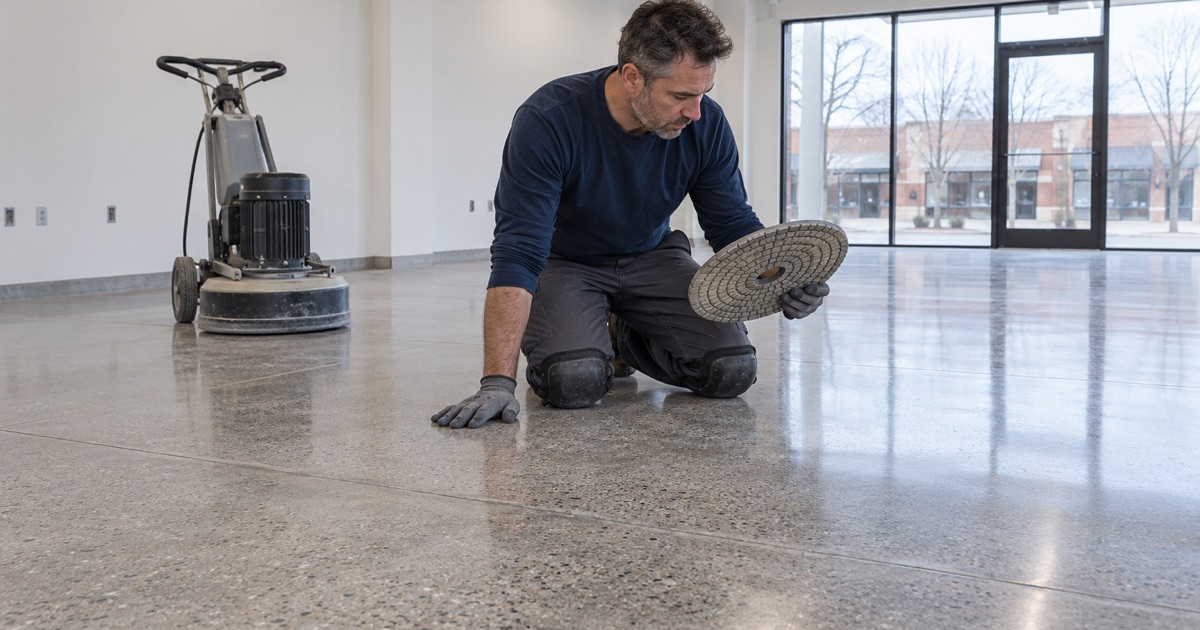
Grinding Through a Diamond Sequence
Polishing starts with coarse metal-bond diamonds that flatten the surface and remove sealers, adhesive and the weak top layer of paste. The floor then passes through progressively finer diamonds, each pass erasing the scratches left by the last, until the surface turns smooth and begins to reflect light. Skipping steps in that sequence is what leaves the swirl marks you sometimes see on cheap jobs.
Hardening With a Lithium Silicate Densifier
Partway through the grinding sequence, we apply a lithium silicate densifier. It soaks into the concrete and reacts with the free lime in the cement paste, filling pores and hardening the surface from within. That denser surface takes a sharper polish, sheds less dust and resists abrasion far better than untreated concrete, which is why densifying is part of every polished floor we install.
Guard and Final Burnish
After the final polishing pass, a penetrating guard is worked into the surface and burnished with a high-speed machine. The guard improves resistance to staining from oil, coffee and spills, and the burnish brings up the final sheen. It is a thin treatment, not a film, so it needs occasional renewal in busy spaces rather than the stripping and recoating a wax finish would demand.
Aggregate Exposure and Sheen Levels
Cream Polish
A cream polish keeps the cut shallow, leaving the smooth paste on the surface with little or no stone showing. It gives a soft, uniform look that suits modern interiors and offices. It also shows trowel marks, color variation and old patches more clearly, so we only recommend it after the test grind shows the paste is even enough to carry the look.
Salt-and-Pepper Finish
Cutting a little deeper exposes the fine sand in the mix, creating a speckled salt-and-pepper look. It hides wear and minor blemishes better than a cream polish and is the most common choice for retail floors and basements. The exposure is rarely perfectly even across an older slab, which is part of its character rather than a defect.
Full Aggregate Exposure
Grinding deeper still reveals the larger stone in the concrete for a terrazzo-like floor. How much stone appears and what color it is depend entirely on the original mix, which is why the test patch matters most here. Full exposure takes more grinding time and suits slabs that are flat and thick enough to give up that much surface without trouble.
Commercial Polished Concrete Floors
Warehouses, Retail and Showrooms
Polished concrete suits large floors that take forklifts, carts and constant foot traffic, because there is no coating to scratch through or peel. It also reflects overhead light, which helps brighten big spaces. We repair joints and spalls before polishing, so wheel traffic does not chip the edges, and we can cut in saw lines or stain zones for branding and wayfinding.
Offices, Schools and Public Buildings
In offices, schools and lobbies, polished concrete replaces carpet and tile with a floor that needs no stripping and waxing. A satin sheen controls glare and footprints in busy corridors. We grind with vacuum extraction to keep dust down, and we pay close attention to how the floor meets door thresholds, elevator sills and other flooring.
Scheduling Around an Operating Building
Grinding is loud, and few businesses can close for a week. We plan polished concrete in phases, working one zone at a time, and run nights or weekends where needed. Because polished concrete has no long cure time, each completed section can usually return to use as soon as the equipment moves on, which keeps disruption to a minimum.
Residential Polished Concrete Floors
Basement Polished Concrete
A basement slab is often a good candidate for polishing, since it is protected from sun and road salt and gains a durable, easy-care floor without adding height. Moisture does not blister polished concrete as it would a coating, but efflorescence can still appear if water moves through the slab. We test first and recommend fixing drainage problems before any floor goes in.
Living Spaces and Heated Slabs
On main-level slabs and additions, polished concrete pairs well with radiant floor heat, holding warmth and releasing it slowly. We locate heating tubes before grinding, cut carefully around them and keep the grind shallow enough to leave the system untouched. Area rugs soften the space acoustically, and the floor needs only routine dust-mopping and damp cleaning.
Where a Coating Fits Better
Polished concrete is not the answer for every room. Garages that take calcium chloride brine every winter, slabs with extensive patching and floors that need a uniform color are often better served by a coated system. When the test grind tells us a slab will not polish into the look you want, we say so plainly and explain the alternatives.
Our Step-by-Step Polished Concrete Process
Step 1: Test Grind and Proposal
We grind a small area to reveal the paste, aggregate and defects in your slab, and we check for coatings, adhesives and moisture. The proposal lays out the exposure level, the densifier and guard, the target sheen and any repairs, so the finished floor can be checked against what was quoted.
Step 2: Repairs and Coarse Grinding
Cracks, spalls and joints are cleaned and filled, and the slab is ground with coarse diamonds to the chosen exposure. This is the stage that sets flatness and uniformity, and it takes the most time on older or uneven floors.
Step 3: Densify, Refine and Polish
The densifier goes on, and the floor moves through finer and finer diamonds until it reaches the sheen you selected. We inspect under raking light between passes to catch scratches before they are locked in by the next step.
Step 4: Guard, Burnish and Handover
The penetrating guard is applied and burnished, and the floor is cleaned and ready for use. You receive maintenance guidance, including the cleaners to use and avoid, so the shine lasts with simple care.
- 20+ Years Coating Concrete
- Moisture Tested Before Quoting
- Itemized Written Proposals