
Arlington Heights Epoxy Flooring has been installing ESD flooring in Arlington Heights, IL for more than 20 years, serving surrounding cities including Prospect Heights, Deerfield, Barrington, Lake Zurich and Wood Dale. ESD stands for electrostatic discharge, the sudden release of built-up static that can damage electronic components, corrupt data or, in some environments, ignite flammable vapors. An ESD floor gives that charge a controlled path to ground every time a person or cart crosses it.
A static-control floor is a measured electrical system, not just a coating with a special name. It needs a grounding grid tied to building ground, resin systems formulated for a specific resistance range, and testing after installation to confirm the floor performs as specified. We build every ESD floor to the range your program requires and hand over the recorded readings at the end of the job.
Like every floor we install, ESD systems start with a slab that has been diamond ground or shot blasted, repaired and tested for moisture. The proposal names each product, the grounding layout, the finished thickness and the resistance range the floor will be tested against.
Conductive and Static-Dissipative Floors
Why Static Control Matters
People build up static charge simply by walking, especially in dry winter air when indoor humidity drops. A discharge too small to feel can still damage sensitive circuit boards, semiconductors and hard drives, often in ways that only show up later as field failures. An ESD floor bleeds that charge away continuously, before it can build into a damaging discharge.
Conductive Flooring
Conductive floors have low electrical resistance and drain static very quickly. They are used where the most sensitive components are handled, and in some areas with flammable or explosive materials where any spark is unacceptable. Because they move charge so readily, they are usually specified alongside strict controls on footwear and equipment grounding.
Static-Dissipative Flooring
Static-dissipative floors have higher resistance than conductive floors and drain charge more slowly and evenly. They suit most electronics assembly, testing and repair areas, server rooms and laboratories. The choice between conductive and dissipative, and the exact range, comes from your ESD control program or equipment manufacturer, and we build to that specification.
How an ESD Floor Is Built
Grounding Grid and Copper Strips
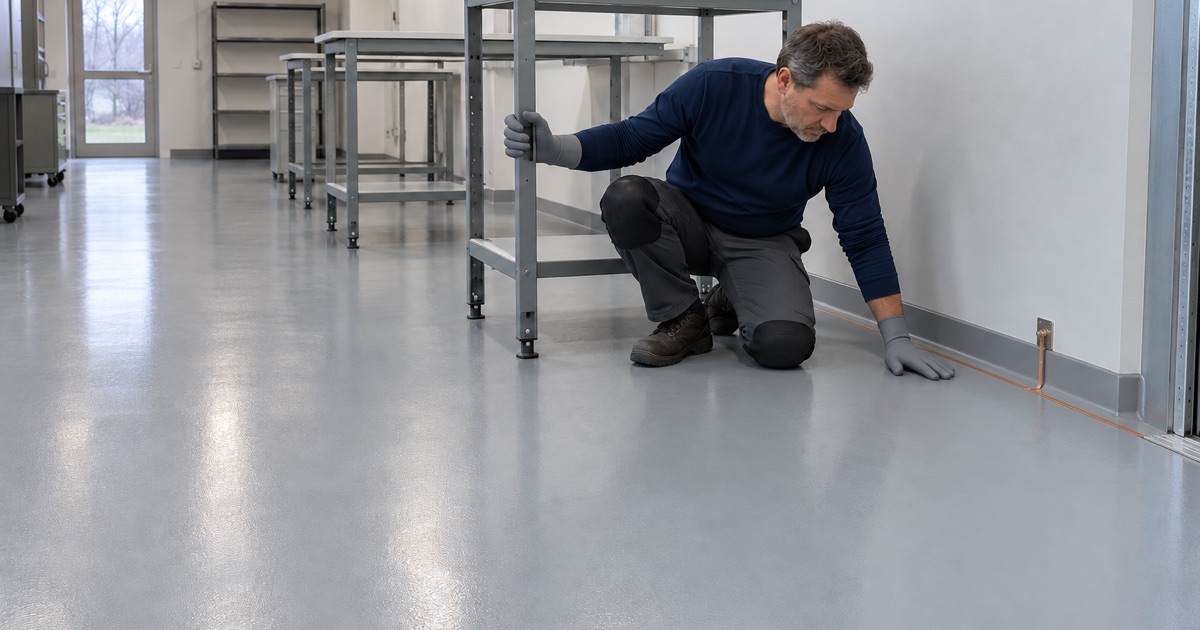
Before any coating goes down, copper grounding strips are laid on the prepared slab in a grid and connected to the building’s electrical ground at set points. This grid gives the charge collected by the floor somewhere to go. Its layout depends on the room size and the system manufacturer’s instructions, and it is recorded in the job documentation.
Conductive Primer and ESD Topcoat
A conductive primer is applied over the slab and grounding strips, linking them into a continuous conductive layer. The ESD body coat or topcoat contains conductive fibers or additives that carry charge from the surface down to that layer. We use 100% solids epoxy or urethane ESD systems, depending on traffic, chemical exposure and the resistance range required.
Slab Preparation and Moisture
An ESD floor only performs if it stays bonded, so preparation is the same as for any high-performance coating: mechanical grinding, crack and joint repair and moisture testing with ASTM F2170 probes or ASTM F1869 kits. Any delamination breaks the conductive path and creates spots that test out of range, which is costly to repair afterward.
Testing and Documentation
Resistance Testing After Installation
Once the system cures, we measure resistance from the floor surface to ground and between points on the floor using a calibrated meter and electrodes, following the test method your specification names. Readings are taken across the room, not just in one spot, so weak areas are found before the floor goes into service.
System Testing With People and Footwear
Some ESD programs require testing the full path from a person through their footwear and the floor to ground, or measuring the voltage a person generates while walking. If your program calls for it, we coordinate that testing with your footwear and procedures, since the floor is only one part of the static control system.
Records and Retesting
At handover, you receive the test readings, the grounding layout and maintenance guidance for your quality records. Floors should be retested on the schedule your program sets and after any repair or recoat. Dirt buildup and the wrong cleaning products are the most common causes of a floor drifting out of range, so cleaning instructions are part of the package.
Where ESD Floors Are Used
Electronics Assembly and Repair
Circuit board assembly, electronics repair and component storage areas are the most common users of static-dissipative floors. These spaces often combine the floor with workstation grounding, wrist straps and ESD footwear, and the floor ties the program together across the whole room rather than at the bench alone.
Server Rooms, Data Spaces and Laboratories
Server rooms, telecom closets and research laboratories use ESD floors to protect equipment and sensitive instruments. Labs may also need chemical resistance, so we choose ESD systems with suitable resin chemistry and can add integral cove bases at the walls for easy cleaning and containment.
Scheduling Around Sensitive Operations
Many ESD spaces cannot be shut down for long, and some are full of equipment that must be moved or protected. We plan installs in phases, coordinate equipment moves with your team and schedule work for shutdowns or weekends. Testing is completed before the space returns to production, so it reopens with documented performance.
- 20+ Years Coating Concrete
- Moisture Tested Before Quoting
- Itemized Written Proposals