Arlington Heights Epoxy Flooring has been installing commercial epoxy flooring in Arlington Heights, IL for more than 20 years, serving surrounding cities including Prospect Heights, Deerfield, Barrington, Lake Zurich and Wood Dale. Our commercial work covers warehouses, distribution centers, food and beverage plants, laboratories, healthcare spaces, auto shops, retail floors and condominium parking garages. Each one asks something different of the floor, and the system we specify starts from that list of demands rather than from a catalog.
Commercial floors fail for the same reasons residential floors do, only at a larger and more expensive scale: poor preparation, unmeasured moisture and a coating chosen for appearance rather than duty. We shot blast or diamond grind every slab, test moisture as a line item, and name each product, layer and finished thickness in the proposal, so facility managers can check the installed system against the specification.
We also understand that few businesses can close for a week. Commercial jobs are phased around production schedules, store hours and tenant access, with fast-curing systems where a zone must reopen quickly.
Matching the System to the Work the Floor Does
High-Build Epoxy for Forklift Traffic
Warehouse and manufacturing floors take forklifts, pallet jacks and dragged loads all day. For those, we use high-build 100% solids epoxy systems, often with a quartz aggregate broadcast for added thickness and grip, finished with an abrasion-resistant topcoat. Joints are repaired and filled first, because hard forklift wheels quickly break down the edges of an open joint.
Chemical Resistance for Plants and Labs
Where acids, solvents, caustic cleaners or process chemicals reach the floor, a standard epoxy may soften or stain. Novolac epoxies and specialty urethanes offer much greater chemical resistance. We match the resin to your actual chemical list and exposure time, and run integral cove bases up the walls so spills cannot reach the floor-to-wall joint.
Urethane Cement for Heat and Washdown
Food plants, breweries and commercial kitchens face hot water, steam cleaning and temperature swings that crack and debond ordinary epoxy. Urethane cement systems handle thermal shock, constant moisture and heavy impact far better, and they tolerate higher slab moisture. We recommend them wherever washdown is hot and frequent.
Commercial Floors Around the O’Hare Corridor
Cross-Dock and Distribution Centers
The industrial belt around O’Hare is full of cross-dock terminals, distribution warehouses and light manufacturing, where floors take constant forklift traffic and pallets dropped at dock doors. Dock edges, staging lanes and turning areas wear first, so we reinforce those zones with thicker builds, repair spalled joints at the dock plates, and plan work to keep doors running.
Food Plants, Cold Storage and Catering Kitchens
Food processing, cold storage and catering operations need floors that are cleanable, slip-resistant and suited to cold or wet conditions. Cooler and freezer floors require systems rated for low temperatures, and food areas under the Illinois Food Code need smooth, nonabsorbent surfaces with coved junctions. We coordinate floor systems with health department plan review where required.
Labs, Healthcare and Associations
Laboratories, clinics and hospital support areas need seamless, chemical-resistant and easily disinfected floors, sometimes with static control. Condominium and townhome associations bring a different job: parking garages and common areas where road brine, tire traffic and drainage are the main concerns. Each gets a system and schedule built for how the space is actually used.
Slip Resistance, Markings and Regulations
Texture and Slip Resistance
OSHA requires walking surfaces to be kept clean, dry where possible and free of hazards, but sets no numeric slip-resistance figure. We control slip resistance through the texture of the system: quartz or aluminum oxide broadcast, grit in the topcoat, and lower sheen in wet areas. We balance grip against cleanability, since a very rough floor is harder to keep clean.
Aisle Lines and Safety Zones
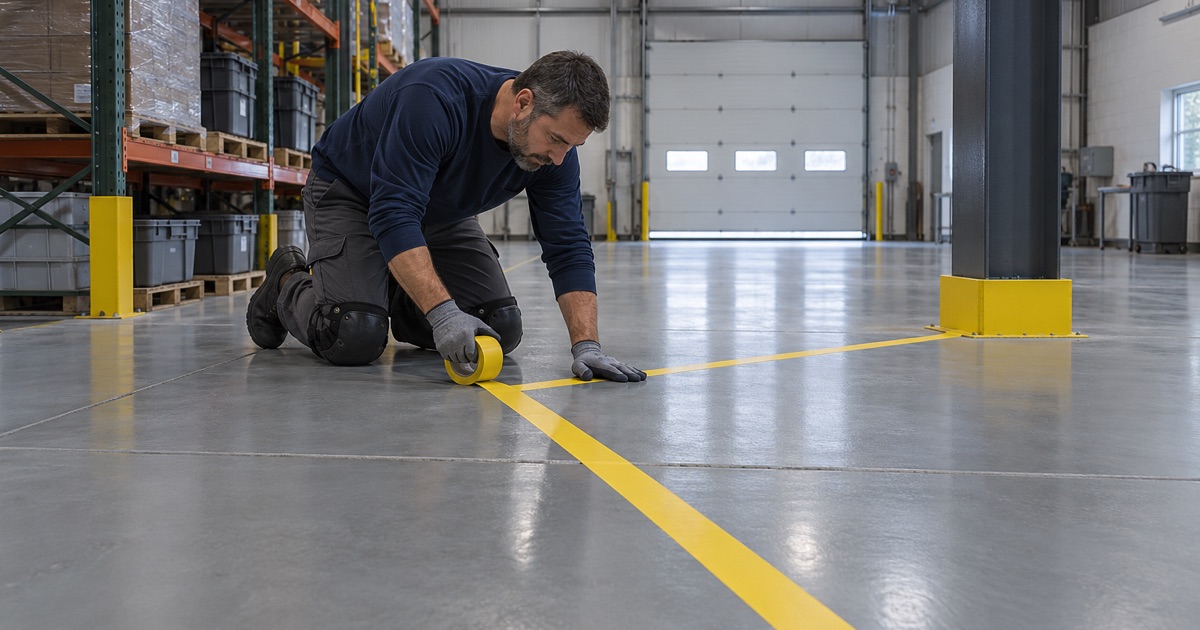
Striping forklift lanes, walkways, hazard areas and storage zones improves safety and organization. We can build colored zones into the coating system or apply durable line coatings over the finished floor. Marking colors and widths follow your facility standard, since OSHA leaves those details to the employer.
Illinois VOC Rules and Ozone Nonattainment
Cook, DuPage, Kane, Lake, McHenry and Will counties sit in the Chicago ozone nonattainment area, now classified as Serious. Illinois limits volatile organic material to 250 g/L for floor coatings and 340 g/L for industrial maintenance coatings, and the rule applies to the contractor applying the product. We choose compliant products and never thin beyond label limits.
Keeping the Building Running
Phased, Night and Weekend Installs
We divide large floors into zones, schedule each around production, deliveries or customer hours, and use fast-curing polyaspartic or urethane systems where a zone must reopen quickly. Clear sequencing keeps forklifts, staff and customers away from curing areas, and the phasing plan is part of the written proposal.
Dust, Odor and Occupied Spaces
Shot blasting and diamond grinding are done with industrial vacuum extraction to control dust, and we choose low-odor products for occupied buildings and food areas. Where odor-sensitive operations are next door, we plan ventilation and timing so the work does not disrupt the rest of the facility.
Moisture and Warranty Terms on Commercial Slabs
Large commercial slabs, especially those on grade without a vapor retarder, can carry significant moisture. We test with ASTM F2170 probes or ASTM F1869 calcium chloride kits and specify a moisture-mitigation primer where readings call for it. The warranty exclusions are reviewed with you before the contract, with moisture vapor named first.
- 20+ Years Coating Concrete
- Moisture Tested Before Quoting
- Itemized Written Proposals